API for Samplers and Composites
You can create your own samplers with dimod’s Sampler abstract base class (ABC)
providing complementary methods (e.g., ‘sample_qubo’ if only ‘sample_ising’ is implemented),
consistent responses, etc.
Properties of dimod Sampler Abstract Base Classes
The following table describes the inheritance, properties, methods/mixins of sampler ABCs.
| ABC | Inherits from | Abstract Properties | Abstract Methods | Mixins |
|---|---|---|---|---|
Sampler |
parameters, properties |
at least one of
sample(), sample_ising(), sample_qubo() |
sample(), sample_ising(), sample_qubo() |
|
Structured |
nodelist, edgelist |
structure, adjacency |
||
Composite |
children |
child |
||
ComposedSampler |
Sampler, Composite |
parameters, properties, children |
at least one of
sample(), sample_ising(), sample_qubo() |
sample(), sample_ising(), sample_qubo(),
child |
PolySampler |
parameters, properties |
sample_poly() |
sample_hising(), sample_hubo() |
|
ComposedPolySampler |
PolySampler, Composite |
parameters, properties, children |
sample_poly() |
sample_hising(), sample_hubo(), child |
The table shows, for example, that the Sampler class requires that you implement
the parameters and properties properties and at least
one sampler method; the class provides the unimplemented methods as mixins.
Creating a Sampler
The Sampler abstract base class (see abc) helps you create new
dimod samplers.
Any new dimod sampler must define a subclass of Sampler that implements
abstract properties parameters and properties
and one of the abstract methods sample(), sample_ising(),
or sample_qubo(). The Sampler class provides the complementary
methods as mixins and ensures consistent responses.
For example, the following steps show how to easily create a dimod sampler. It is
sufficient to implement a single method (in this example the sample_ising() method)
to create a dimod sampler with the Sampler class.
class LinearIsingSampler(dimod.Sampler):

    def sample_ising(self, h, J):
        sample = linear_ising(h, J)
        energy = dimod.ising_energy(sample, h, J)
        return dimod.SampleSet.from_samples([sample], energy=[energy]})

    @property
    def properties(self):
        return dict()

    @property
    def parameters(self):
        return dict()
For this example, the implemented sampler sample_ising() can be based on
a simple placeholder function, which returns a sample that minimizes the linear terms:
def linear_ising(h, J):
    sample = {}
    for v in h:
        if h[v] < 0:
            sample[v] = +1
        else:
            sample[v] = -1
    return sample
The Sampler ABC provides the other sample methods “for free”
as mixins.
sampler = LinearIsingSampler()
response = sampler.sample_ising({'a': -1}, {})  # Implemented by class LinearIsingSampler
response = sampler.sample_qubo({('a', 'a'): 1})  # Mixin provided by Sampler class
response = sampler.sample(BinaryQuadraticModel.from_ising({'a': -1}, {}))  # Mixin provided by Sampler class
Below is a more complex version of the same sampler, where the properties and
parameters properties return non-empty dicts.
class FancyLinearIsingSampler(dimod.Sampler):
    def __init__(self):
        self._properties = {'description': 'a simple sampler that only considers the linear terms'}
        self._parameters = {'verbose': []}

    def sample_ising(self, h, J, verbose=False):
        sample = linear_ising(h, J)
        energy = dimod.ising_energy(sample, h, J)
        if verbose:
            print(sample)
        return dimod.SampleSet.from_samples([sample], energy=[energy]})

    @property
    def properties(self):
        return self._properties

    @property
    def parameters(self):
        return self._parameters
-
class
Sampler[source]¶ Abstract base class for dimod samplers.
Provides all methods
sample(),sample_ising(),sample_qubo()assuming at least one is implemented.
Abstract Properties
Sampler.parameters |
A dict where keys are the keyword parameters accepted by the sampler methods and values are lists of the properties relevent to each parameter. |
Sampler.properties |
A dict containing any additional information about the sampler. |
Mixin Methods
Sampler.sample(bqm, **parameters) |
Sample from a binary quadratic model. |
Sampler.sample_ising(h, J, **parameters) |
Sample from an Ising model using the implemented sample method. |
Sampler.sample_qubo(Q, **parameters) |
Sample from a QUBO using the implemented sample method. |
Creating a Composed Sampler
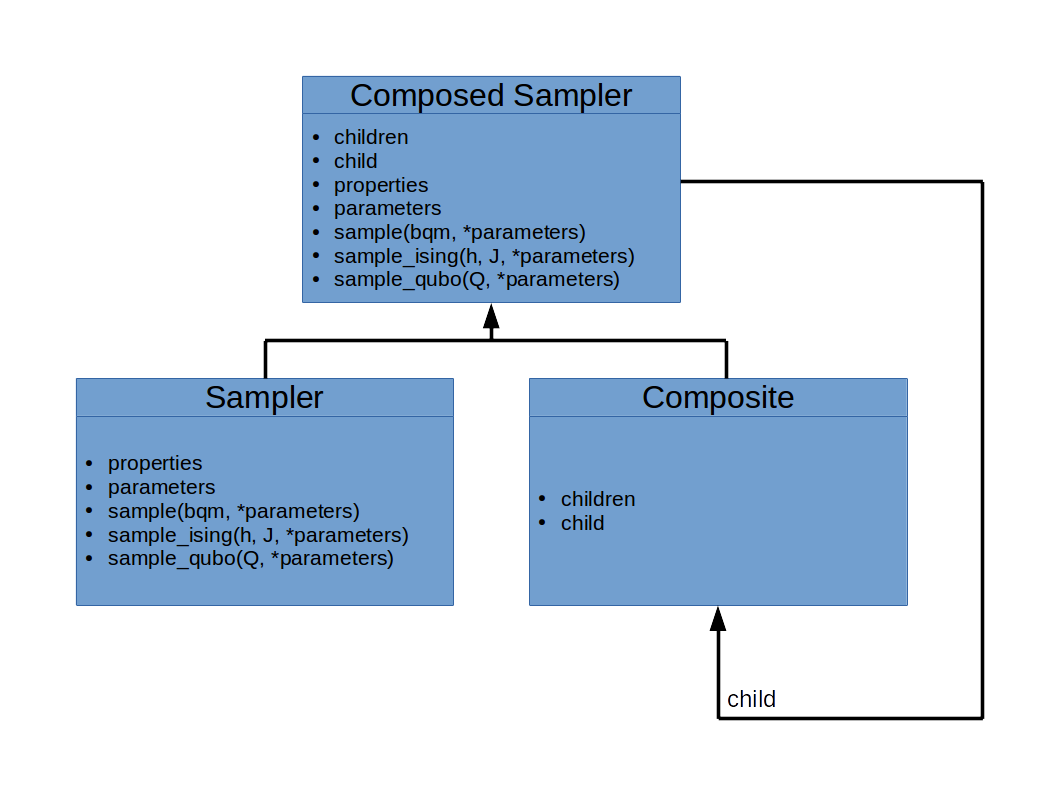
Composite Pattern
Samplers can be composed. The composite pattern allows layers of pre- and post-processing to be applied to binary quadratic programs without needing to change the underlying sampler implementation.
We refer to these layers as composites. Each composed sampler must include at least one sampler, and possibly many composites.
Each composed sampler is itself a dimod sampler with all of the included methods and parameters. In this way complex samplers can be constructed.
The dimod ComposedSampler abstract base class inherits from Sampler class
its abstract methods, properties, and mixins (for example, a sample_Ising method) and from
Composite class the children property and child mixin (children being a list of
supported samplers with child providing the first).
Examples
The dimod package’s spin_transform.py reference example creates a composed sampler, SpinReversalTransformComposite(Sampler, Composite), that performs spin reversal transforms (“gauge transformations”) as a preprocessing step for a given sampler. The reference example implements the pseudocode below:
class SpinReversalTransformComposite(Sampler, Composite):

    # Updates to inherited sampler properties and parameters
    # Definition of the composite's children (i.e., supported samplers):
    children = None
    def __init__(self, child):
        self.children = [child]

    # The composite's implementation of spin-transformation functionality:
    def sample(self, bqm, num_spin_reversal_transforms=2, spin_reversal_variables=None, **kwargs):
        response = None
        # Preprocessing code that includes instantiation of a sampler:
        # flipped_response = self.child.sample(bqm, **kwargs)
        return response
Given a sampler, sampler1, the composed sampler is used as any dimod sampler. For example, the composed sampler inherits an Ising sampling method:
>>> composed_sampler = dimod.SpinReversalTransformComposite(sampler1) # doctest: +SKIP
>>> h = {0: -1, 1: 1} # doctest: +SKIP
>>> response = composed_sampler.sample_ising(h, {}) # doctest: +SKIP
-
class
Composite[source]¶ Abstract base class for dimod composites.
Provides the
childmixin property and defines thechildrenabstract property to be implemented. These define the supported samplers for the composed sampler.
Abstract Properties
Composite.children |
List of child samplers that that are used by this composite. |
Mixin Properties
Composite.child |
The child sampler. |
Creating a Structured Sampler
A structured sampler can only sample from binary quadratic models with a specific graph.
For structured samplers you must implement the nodelist
and edgelist properties. The Structured abstract base class
provides access to the structure and adjacency
properties as well as any method or properties required by the Sampler abstract
base class. The bqm_structured decorator verifies that any given binary quadratic
model conforms to the supported structure.
Examples
This simple example shows a structured sampler that can only sample from a binary quadratic model with two variables and one interaction.
class TwoVariablesSampler(dimod.Sampler, dimod.Structured):
    @property
    def nodelist(self):
        return [0, 1]

    @property
    def edgelist(self):
        return [(0, 1)]

    @property
    def properties(self):
        return dict()

    @property
    def parameters(self):
        return dict()

    @dimod.decorators.bqm_structured
    def sample(self, bqm):
        # All bqm's passed in will be a subgraph of the sampler's structure
        variable_list = list(bqm.linear)
        samples = []
        energies = []
        for values in itertools.product(bqm.vartype.value, repeat=len(bqm)):
            sample = dict(zip(variable_list, values))
            samples.append(sample)
            energies.append(bqm.energy(sample))

        return dimod.SampleSet.from_samples(samples, bqm.Vartype, energies)

        return response
-
class
Structured[source]¶ The abstract base class for dimod structured samplers.
Provides the
Structured.adjacencyandStructured.structureproperties.Abstract properties
nodelistandedgelistmust be implemented.
Abstract Properties
Structured.nodelist |
Nodes/variables allowed by the sampler. |
Structured.edgelist |
Edges/interactions allowed by the sampler in the form [(u, v), …]. |
Mixin Properties
Structured.adjacency |
Adjacency structure formatted as a dict, where keys are the nodes of the structured sampler and values are sets of all adjacent nodes for each key node. |
Structured.structure |
Structure of the structured sampler formatted as a namedtuple, Structure(nodelist, edgelist, adjacency), where the 3-tuple values are the nodelist, edgelist and adjacency attributes. |
Creating a Binary Polynomial Sampler
Samplers that handle binary polynomials: problems with binary variables that are not constrained to quadratic interactions.
-
class
PolySampler[source]¶ Sampler that supports binary polynomials.
Binary polynomials are an extension of binary quadratic models that allow higher-order interactions.
Abstract Properties
PolySampler.parameters |
A dict where keys are the keyword parameters accepted by the sampler methods and values are lists of the properties relevant to each parameter. |
PolySampler.properties |
A dict containing any additional information about the sampler. |
Abstract Methods
PolySampler.sample_poly(polynomial, **kwargs) |
Sample from a higher-order polynomial. |
Mixin Methods
PolySampler.sample_hising(h, J, **kwargs) |
Sample from a higher-order Ising model. |
PolySampler.sample_hubo(H, **kwargs) |
Sample from a higher-order unconstrained binary optimization problem. |
Creating a Composed Binary Polynomial Sampler
-
class
ComposedPolySampler[source]¶ Abstract base class for dimod composed polynomial samplers.
Inherits from
PolySamplerandComposite.