Embedding
Provides functions that map binary quadratic models and samples between a source graph and a target graph.
Example
A sampler may not natively support a given problem graph. For example, the D-Wave system does not natively support \(K_3\) graphs. The Boolean AND gate (\(x_3 \Leftrightarrow x_1 \wedge x_2\) where \(x_3\) is the AND gate’s output and \(x_1, x_2\) the inputs) may be represented as penalty model
This penalty model can in turn be represented as the QUBO,
which is a fully connected \(K_3\) graph.
Sampling this problem on a D-Wave system, therefore, requires minor-embedding. Embedding in this case is accomplished by an edge contraction operation on the target graph: two nodes (qubits) are chained to represent a single node.
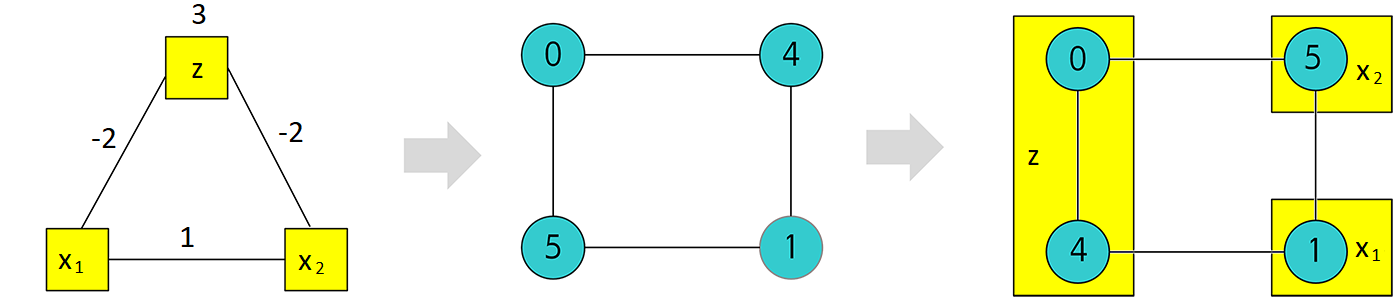
Embedding an AND gate represented by a \(K_3\) graph onto the D-Wave system’s graph. The leftmost graph is the source graph, which is the QUBO representing the AND gate; the middle one is the target graph, representing the D-Wave system; and in the rightmost graph, qubits 0 and 4 of the D-Wave system’s graph are chained to represent the single node \(z\) of the source graph.
Functions
embed_bqm(source_bqm, embedding, …[, …]) |
Embed a binary quadratic model onto a target graph. |
embed_ising(souce_h, source_J, embedding, …) |
Embed an Ising problem onto a target graph. |
embed_qubo(source_Q, embedding, target_adjacency) |
Embed a QUBO onto a target graph. |
iter_unembed(target_samples, embedding[, …]) |
Yield unembedded samples. |
unembed_response(target_response, embedding, …) |
Unembed the response. |
chain_break_frequency(samples, embedding) |
Determine the frequency of chain breaks in the given samples. |
Chain-Break Resolution
Chain-break-resolution generators available to iter_unembed().
Chain-break-resolution generators enable iter_unembed() to use different techniques
of resolving chain breaks without keeping large numbers of samples in memory. Each generator
yields zero or more unembedded samples.
Generators
discard(sample, embedding) |
Discard the sample if a chain is broken. |
majority_vote(sample, embedding) |
Determine the sample values for chains by majority vote. |
weighted_random(sample, embedding) |
Determine the sample values of chains by weighed random choice. |
Callable Objects
MinimizeEnergy([linear, quadratic]) |
Determine the sample values of broken chains by minimizing local energy. |